

Summary
Media and social media are full of opinions about AI’s impact on the US economy and labor market. My view is that most of the debate is badly underestimating how much AI has already changed both.
The evidence, as I read it, points to a much larger impact than the conventional view allows. This matters because a consensus that says “not yet” is a consensus that prepares for nothing, at exactly the moment preparation is still possible.
Proving that any particular economic development was caused by AI is extraordinarily difficult. The economy offers no clean experiments, and AI is arriving alongside many other changes. What follows is therefore not definitive proof. It is my reading of the evidence.
1. Growth is stronger than it looks, and AI is the biggest reason.
I put underlying GDP growth right now at about 3 percent at a time when the population is barely growing, implying unusually strong growth in GDP per capita. The main driver is a surge in business investment, much of it AI-related. The usual measure of AI investment counts only the visible part, chips, data centers and power; the plants and grid that have to be built to build them are not labeled AI in anyone’s accounts, so the measured contribution is a floor. When actual spending beats expectations three years running, the problem is the expectations.
The impact goes beyond direct investment. The AI-driven surge in technology stocks has created a large wealth effect, sustaining solid consumer spending even though job growth outside health care has been close to zero over the past two years. Between the investment boom and the wealth effect, AI has been a major reason the economy kept growing nicely despite tariffs, federal spending cuts, the war with Iran, and unusually high uncertainty.
2. Productivity has stepped up, and the gains are concentrated where technology is changing work fastest.
Productivity has grown about 2.5 percent a year over the three years through mid-2026, more than twice its pace in the 2010s. That is too large, and has lasted too long, to be noise.
The gains are also highly concentrated. They are strongest in finance, insurance, information, and professional and business services, what I call FIIPB, where much of America’s office work is done and AI use is high. Productivity in those industries has grown about 4 percent a year. Growth is also elevated in advanced manufacturing and retail, two sectors being reshaped rapidly by technology. Across much of the rest of the economy, productivity growth has been close to zero.
That pattern doesn’t prove AI caused the acceleration, but it is one of the main reasons I think AI and related technologies are already contributing a lot. If this were a broad cyclical rebound, I’d expect the gains to be spread more evenly. Instead they’re concentrated in the parts of the economy where technology is changing work fastest.
3. The missing jobs aren’t a weak economy. They’re productivity.
Job growth has been weak for two years. Payrolls have grown by about 1.3 million over the 24 months through August, roughly 55,000 a month, and outside health care and social assistance the economy has added essentially no jobs. Most people read that as weakness. I read it as productivity.
Weak hiring is usually taken as a sign that demand is weak. That’s hard to square with output. Output has kept growing while employment and hours have barely moved, so firms are producing considerably more without adding many workers. Whatever its cause, that is higher productivity.
The clearest example is FIIPB. For 36 straight months, from September 2023 through August 2026, employment in these industries was lower than a year earlier even as employment in the rest of the economy kept rising. Every other run like that since 1990 came during or right after a recession. This one didn’t. These industries had been major engines of US job growth for decades. Something changed around 2023.
At the same time, from the end of 2022 through the end of 2025, real output in FIIPB rose about 13 percent while hours worked fell about 2 percent. More output with fewer hours is productivity.
The harder question is what caused it. I think AI and related technologies are an important part of the answer, but not the whole answer. So far, the clearest employment effects from actual AI deployment appear in clerical and other routine jobs, where tasks are easy to codify and carry less judgment or responsibility. Within professional occupations, existing evidence points to larger effects at the entry level, where more of the work is research, drafting, coding and analysis, tasks today’s systems can increasingly do.
There is also an anticipatory effect on hiring. Firms don’t staff for today’s technology; they hire for the work they expect to need over the next several years. If employers expect AI to absorb a growing share of certain tasks, they get more cautious about adding headcount before deployment is complete.
4. Young graduates are the exception in a low-unemployment labor market.
Since late 2022, unemployment among bachelor’s degree holders aged 22 to 27 has risen about 1.5 percentage points, three times the increase for young workers without a degree and about twice the increase for older graduates. Young-graduate unemployment is now unusually high for an expansion, and their pay advantage is shrinking.
Broad economic weakness can’t explain a pattern this specific. Nor can the post-2022 tech layoffs: the deterioration has spread well beyond tech and has now lasted three years past that correction. I think AI is an important mechanism. Much of the work that used to go to junior professionals is work AI can now do, and firms expecting it to do more are hiring fewer of them.
A longer-running trend is making the problem worse. The share of each cohort earning a bachelor’s degree has risen for decades, so more graduates are competing for a slow-growing pool of entry-level professional jobs. That glut didn’t cause the recent deterioration, but it means a hit to demand lands harder than it would have a generation ago.
5. The studies that find nothing are using the wrong variable.
Studies finding no measurable AI effect on the labor market go viral and fuel the belief that AI hasn’t yet had an impact. Most rely on AI exposure scores, find little relationship with employment, and conclude that AI is not doing much. I largely discount those conclusions because exposure, even if measured correctly, is not the same thing as displacement.
Exposure scores do not tell us whether employers actually adopt AI, whether it substitutes for labor, or whether demand expands enough to absorb the extra output. Using exposure on its own as the sole proxy for AI’s labor-market impact is a non-starter. A null result from that test is not strong evidence that the true effect is small.
6. The big job losses haven’t happened yet. They’ll come in the next recession.
Firms have barely started. The gap between what the best models can do and what most firms actually use them for is enormous, and I expect it to keep growing. Closing that gap will be one of the most important forces shaping the US economy and labor market in the coming years and decades.
Conditions so far have been unusually forgiving. There has been no recession since ChatGPT’s release. Growth has been solid, corporate profits are at a record share of GDP, and the layoff rate is about as low as it gets. AI is also creating jobs. Thousands of AI companies are founded every year, concentrated in tech hubs like the Bay Area, and existing firms are adding AI roles at a faster clip still. I estimate that 1.5 to 2 percent of knowledge workers now hold jobs that would not exist without AI. And that count excludes the physical buildout: the data centers, power plants, transmission lines, and chip fabs behind the AI boom are employing electricians, construction crews, engineers, and technicians in significant numbers.
That combination has produced a wave of articles declaring the AI job apocalypse dead. I think they’re premature. Firms make their biggest workforce cuts in recessions, when they have both the opportunity and the pressure to restructure. The manufacturing experience is a useful warning: the impact of automation looked much smaller in 2000 than it did by 2010, after two recessions had forced firms to reorganize around the technology. By the next downturn, employers will have had years to learn where AI can substitute for labor. I expect large cuts in office jobs when it comes, and I don’t expect many of those jobs to come back. That young college graduates are struggling even in today’s favorable conditions is what worries me most.
The prevailing view that AI has not yet affected the labor market much is not a harmless analytical mistake. It tells policymakers, colleges, and young workers: no rush. If I am right, the next recession will make these effects much more visible. By then, employers will have had years to learn where AI can substitute for labor, and many adjustments that could have been made gradually will become much harder. The time to prepare for that labor market is before it arrives.
Introduction
For the decade before the pandemic I was a techno-skeptic, and I said so in public. The automation wave that was supposed to hollow out the middle of the labor market kept not arriving, productivity growth stayed under 1 percent a year, and I spent a lot of that time telling audiences that the robot stories were running ahead of the evidence. Then I opened ChatGPT in December 2022, and I changed my mind faster than I have changed it about anything else in my career.
I think many economists underestimate how much AI is already changing the US economy and its labor market. The economy is doing things that don’t usually show up together. Economic Growth is strong and profits are at a record while job growth has almost stopped, and overall unemployment is low while young college graduates are having a hard time. I think AI connects most of these.
A word on what this piece can and can’t show. There is no experiment here. AI arrived in the same three years as high interest rates, the unwinding of pandemic hiring, federal cuts and an immigration slowdown, and nothing in the aggregate data lets anyone assign shares to each. So I won’t claim proof. What I can do is lay out the patterns, say which ones I can document, and be clear about where I’m reading the evidence rather than measuring it.
Growth is stronger than it looks, and AI is the biggest reason
The economy is growing well. I put underlying GDP growth at about 3 percent. My gauge is final sales to private domestic purchasers, which is consumer spending plus private fixed investment and strips out the noisy parts of GDP: inventories, trade and government. It grew at a 3 percent annual rate in the first half of the year and is expected to grow even faster in the third quarter. The outlier is business investment that is probably growing at double digits rate in the first 3 quarters of 2026.
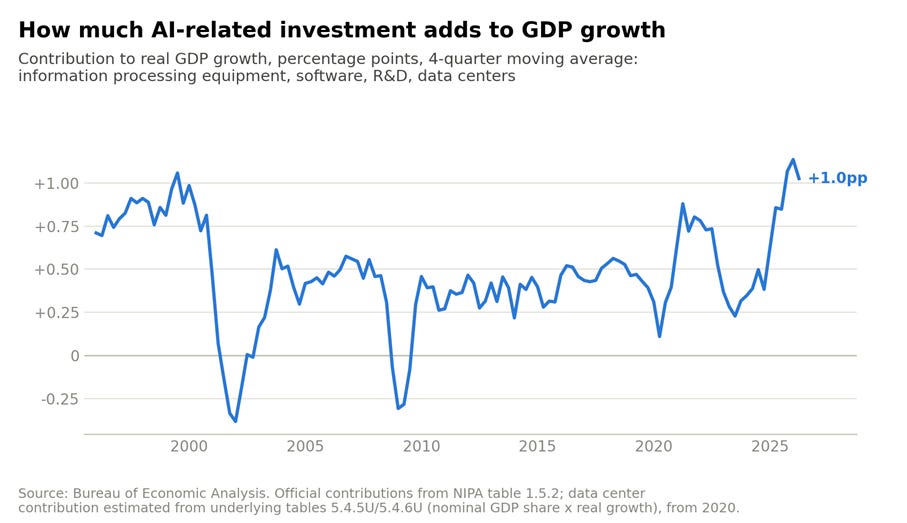
Chart 1. What AI-related investment adds to GDP growth.
Companies are pouring money into data centers, chips, electricity, equipment, software and R&D. That spending adds to GDP directly, at historically high rates, and indirectly when it becomes income for suppliers and their workers. Corporate profits are at a record share of GDP, so companies can keep paying for all of it. Advanced manufacturing is experiencing a recovery.
That contribution figure is a floor, and not only because of imports. It counts the visible part of the buildout: chips, servers, software and data centers. It doesn’t count the transformer plants, turbine lines, substations, gas plants, smelters and training programs that have to exist before the next round of data centers can be built, because none of that is labeled AI in the national accounts. Some of it would have been built anyway. Most of it is being ordered now and arrives in 2027 to 2029, and unlike the servers, almost all of it is built here. The boom has more years in it, and more domestic content, than the capex headlines suggest.
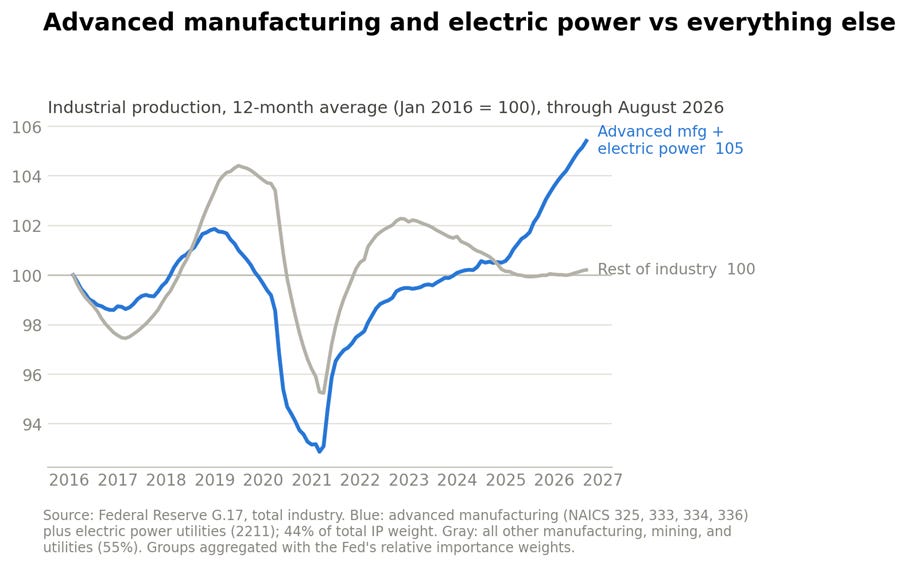
Chart 2. Output of advanced manufacturing and electric power against the rest of industry.
Consumers are the other source of support. Real spending has continued to grow solidly despite almost no job growth outside health care, weak income growth, and still-elevated inflation. I think a major reason is the wealth effect from the AI-driven stock market boom. Rising equity wealth is supporting spending even as labor-market momentum fades. But the effect is highly uneven: stock ownership is concentrated, so most of the gains, and much of the resulting boost to consumption, accrue to a relatively small share of households.
That support is also why the shocks of the past two years didn’t do what most forecasters expected. Tariffs, federal spending cuts, the war with Iran and unusually high uncertainty all hit an economy that kept growing anyway. I don’t think that was luck. The investment boom put income into suppliers and their workers, the wealth effect kept households spending, and between them they absorbed shocks that in most years would have tipped the economy into recession.
All of this is happening at a time when population is barely growing at all. GDP per capita growth of about 3% is well above average in recent decades.
Productivity has stepped up, and the gains are concentrated where technology is changing work fastest
How does an economy grow this fast while adding so few jobs? The answer is productivity: firms are meeting demand with the same or fewer people. As for the cause, much of this is because of AI. I can’t prove that, but it’s where I come down.
In 2024, 2025 and 2026, labor productivity in the non-farm business sector is likely to average above 2.5 percent. More than double in the decade before the pandemic, and I believe it’s a real long-term trend.
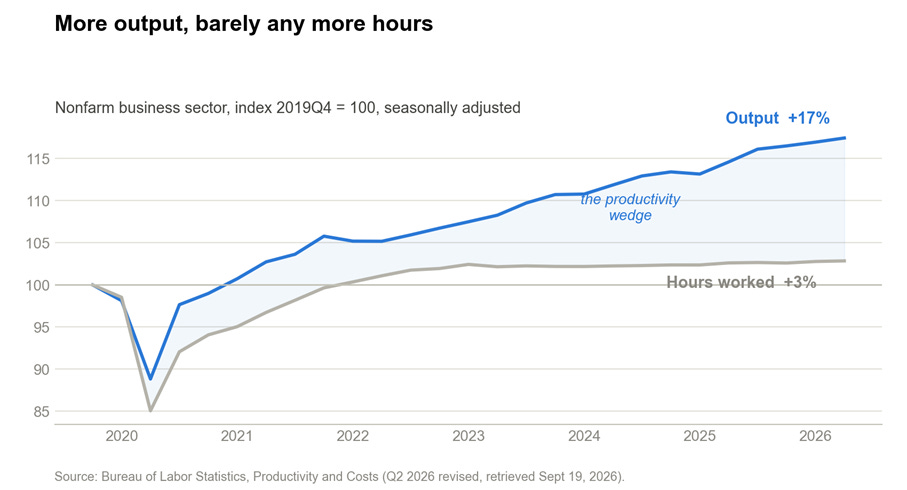
Chart 3. Business output against hours worked since the end of 2019.
The gains are concentrated in the industries I group as FIIPB, which is finance, insurance, information, and professional and business services, and they also show up in retail and advanced manufacturing. If this were a broad cyclical rebound, the gains would be spread more evenly. They aren’t, and that is a big part of why I credit AI and the technologies around it. When productivity rises faster than demand for what an industry sells, it needs fewer workers. Since the end of 2019, business output is up about 17 percent on about 3 percent more hours. Within that, the industry data put FIIPB productivity growth at about 4 percent a year on the latest readings, with advanced manufacturing and retail also well above the economy-wide pace and much of the rest of the economy close to zero.
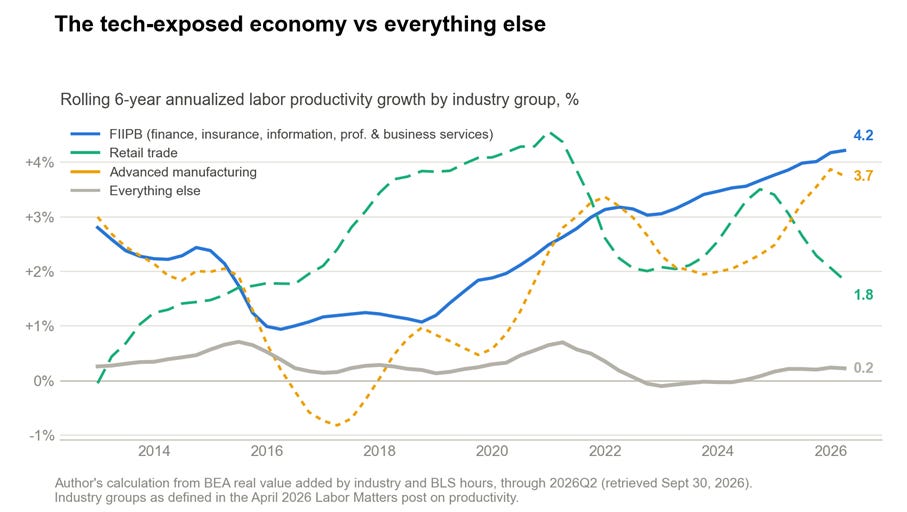
Chart 4. Productivity growth in FIIPB, retail and advanced manufacturing against everything else.
The gains also differ between countries. The US is pulling away from Europe. Since 1995 output per hour has risen about 70 percent here against about 30 percent in the euro area, and over the past six years it grew 12 percent against 2. The US produces this technology and Europe mostly uses it, so more of the profits, the investment and the high-productivity jobs end up on this side of the Atlantic. I think AI widens that gap.
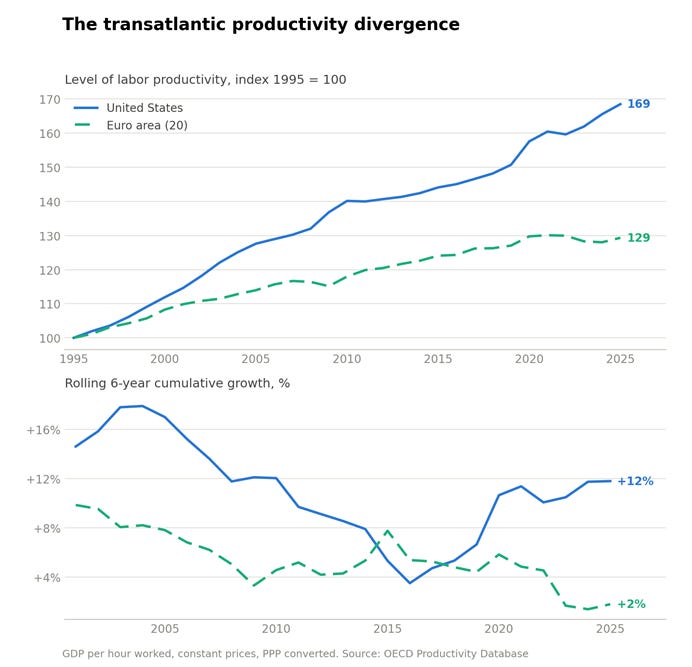
Chart 5. Labor productivity in the United States and the euro area.
The missing jobs aren’t a weak economy. They’re productivity
Job growth is weak. Payrolls have added about 1.3 million jobs over the 24 months through August, roughly 55,000 a month, and nearly all of it came from health care and social assistance. Without them the number of jobs is about the same as 2.5 years ago. While many attribute it to the economy, as discussed above, the economy is strong, and the reason for the weak job growth is productivity.
Job growth is weak overall and outright negative in FIIPB, which has shed about 700,000 jobs since April 2023. The output didn’t go with them: real value added in these industries rose about 13 percent between the end of 2022 and the end of 2025 while hours worked fell about 2 percent. Measured against where FIIPB employment would normally be, between 1.5 and 2.6 million white-collar jobs are missing, depending on the method. I estimated the gap in April and updated it this month.
The obvious alternative is that this is the unwinding of pandemic overhiring plus a rate cycle. Finance, information and professional services were among the most overhired sectors in 2021 and 2022 and among the most rate-sensitive, so a correction there is exactly what you’d expect. I don’t think it holds. A correction ends, and this one hasn’t. It ran through 175 basis points of rate cuts before the Fed’s September increase. Output in these industries kept rising the whole time. And a correction would cut across the board, but clerical work fell while professional work held.
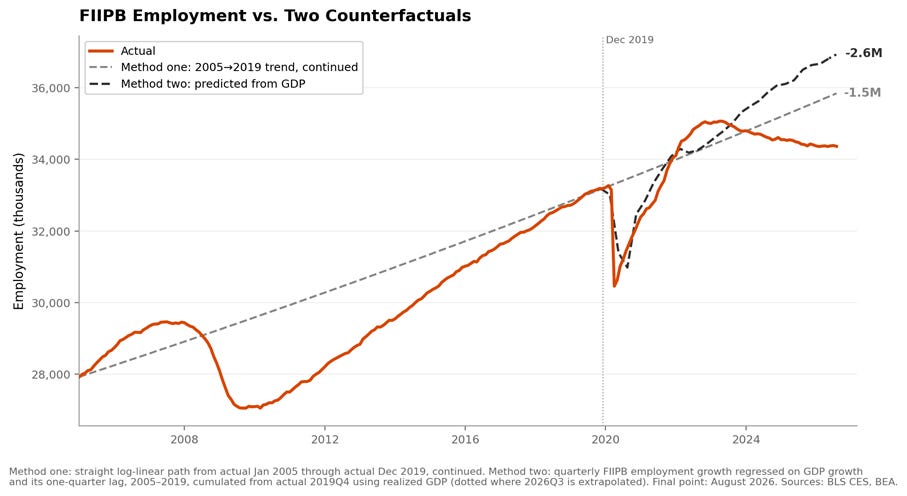
Chart 6. FIIPB employment against two estimates of where it would normally be.
Clerical work is falling while professional work is holding up. And the fall in clerical work varies across industries. Not surprising, the largest drop in clerical work employment is happening in FIIPB industries.
Automation is also creeping into some professional occupations, HR specialists and insurance underwriters among them. That is already happening and I expect it to continue, as I wrote in July. What protects a job is judgment and face-to-face work. In the occupation data for 2023 to 2025, how much judgment a job requires is the best predictor I’ve found of which white-collar occupations grew.
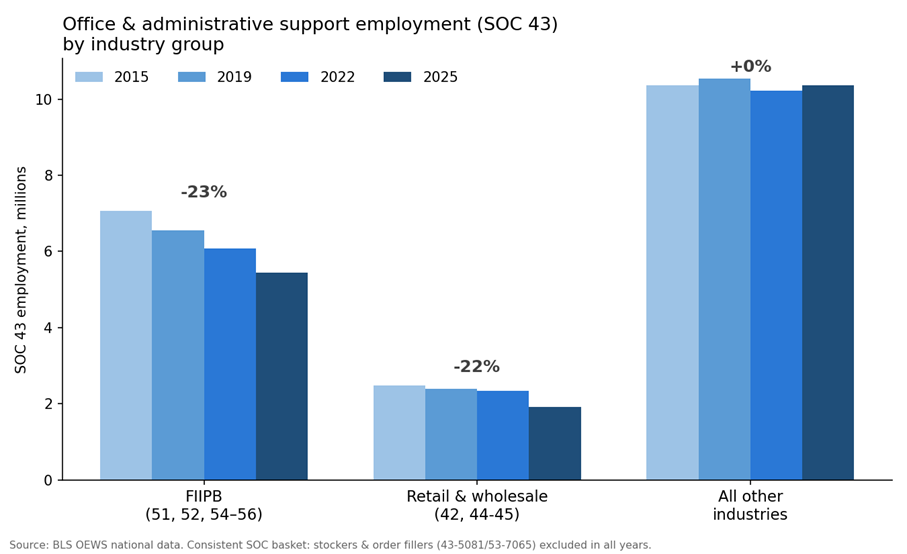
Chart 7. Office and administrative support jobs by industry group, 2015 to 2025.
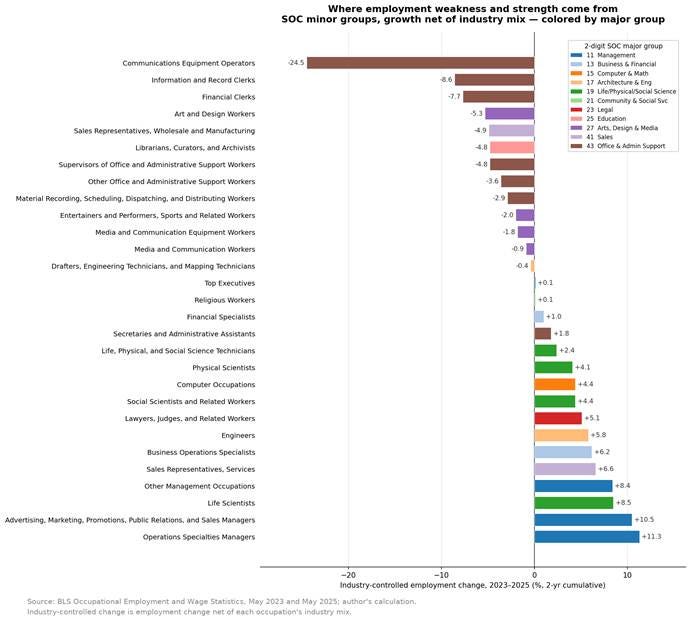
Chart 8. Employment change by occupation group, 2023 to 2025, net of industry mix.
Some of the effect of AI on jobs arrives before any of the technology does. A company that expects AI to handle a chunk of the work within two years has a reason to leave a role unfilled now, and that decision costs nothing to make. Executives believe AI is transformative and their boards expect them to act on it, and the cheapest way to act is to stop adding people.
Based on the above, we should not be surprised that workers in FIIPB behave differently when it comes to quitting. Job hugging, the reluctance to leave a job, is mostly a private white-collar thing. In FIIPB the quits rate is near the bottom of its range since 2001 and so is the hires rate, while layoffs are about normal. Companies stopped hiring, so there are no outside offers, and people hold on to what they have. In government, education and health care, where jobs are mostly still being added, quits are high.
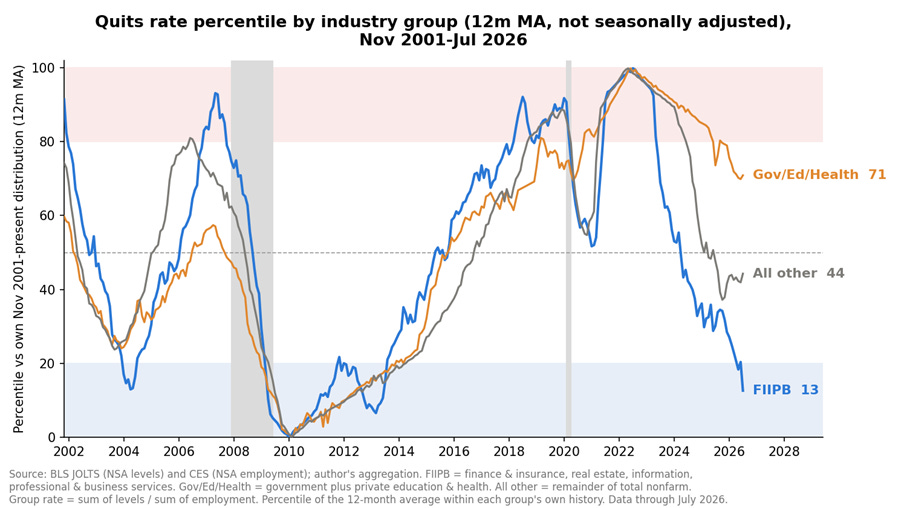
Chart 9. Quits rates by industry group, ranked against their own history.
A natural question at this stage is why is unemployment still low with job growth this weak? The working-age population has stopped growing and immigration has slowed, so the economy doesn’t need many new jobs to keep unemployment steady. In some sense we’re lucky. AI and the labor supply squeeze arrived at the same time, and they partly cancel each other out.
Young graduates are the exception in a low-unemployment labor market
Since weaker job growth runs through hiring, its cost falls on the people who need to be hired, and in white-collar fields those are new graduates. They are hit a second way, because AI does the tasks juniors used to do. A junior economist is much more automatable than a senior economist. So for now displacement is concentrated at the entry level, and that’s why young college graduates are the exception in an otherwise low-unemployment labor market.
Since late 2022, on 12-month averages through August, the unemployment rate for bachelor’s degree holders aged 22 to 27 has risen about 1.5 points, three times the rise for young workers without a degree and about twice the rise for graduates over 30. Their unemployment is up, and there is evidence that the wage gap between young workers with a bachelor’s degree and those with an associate degree has been shrinking. At 22 to 24, a bachelor’s degree used to be worth 36 percent more than an associate’s in median weekly earnings. Now it’s 27 percent, on 24-month averages, and that is the lowest since at least 2008. They are the group doing worst.
A longer-running trend makes the hit land harder. The share of each cohort finishing a bachelor’s degree has risen for decades, so more graduates are competing for a pool of entry-level professional jobs that was growing slowly even before 2022. That glut didn’t cause the recent deterioration, but it means a drop in demand for junior work shows up in their unemployment rate faster than it would have a generation ago.
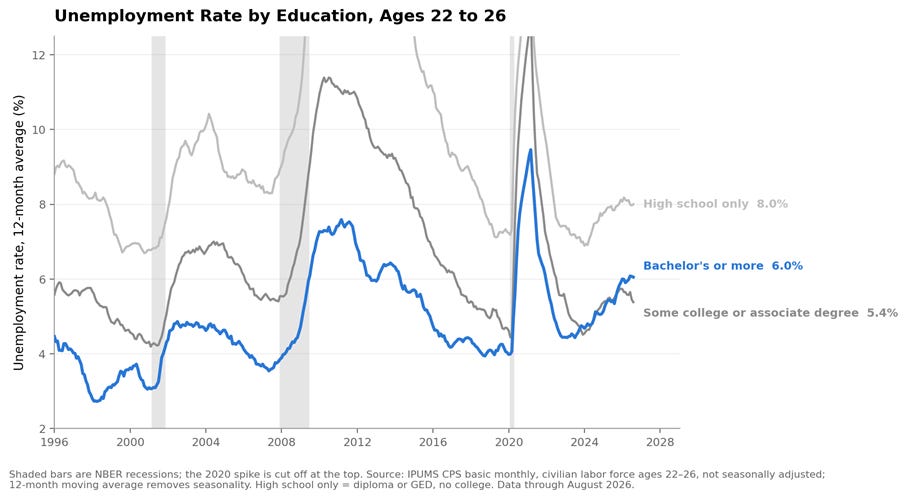
Chart 10. Unemployment rates by education, ages 22 to 26.
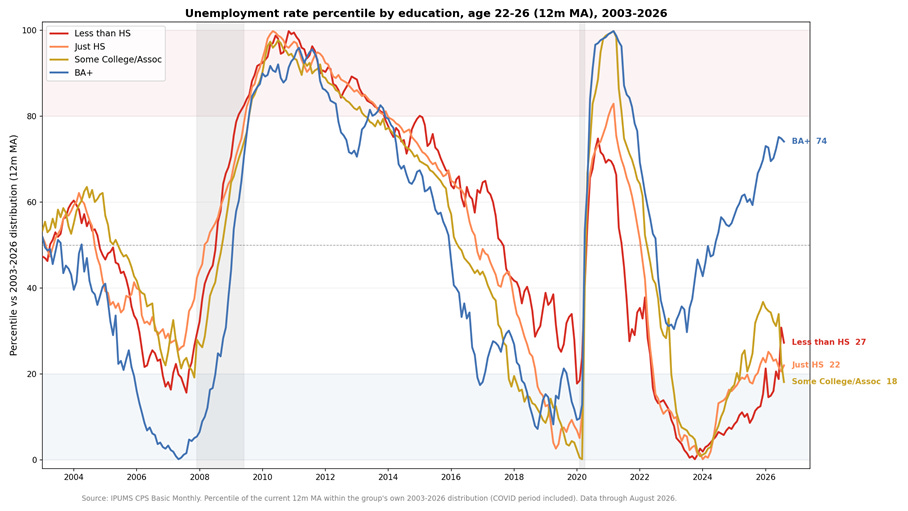
Chart 11. Unemployment by education, ages 22 to 26, ranked against each group’s own history.
The split shows up inside the professions too. Unemployment for computer, engineering and science workers tracked other professionals through most of the 2010s and has been higher since 2024. The gap is about half a point, the widest since 2010.
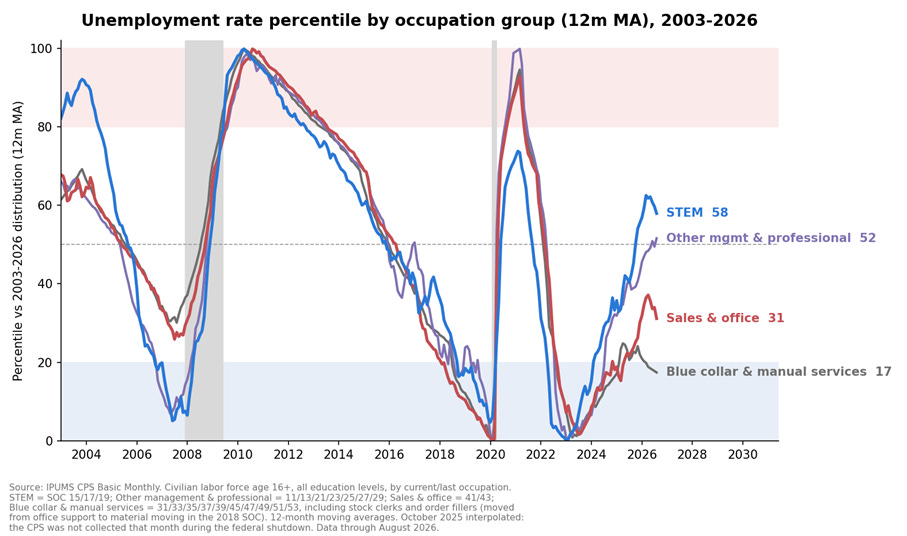
Chart 12. Unemployment by occupation group, ranked against each group’s own history.
Workers without a bachelor’s degree, by contrast, are doing well. Their unemployment rate is lower than in about three quarters of the months since 2003. Part of that is real strength in health care, construction and other work that has to be done in person. Part of it is the labor supply squeeze again: the immigration slowdown and a working-age population that isn’t growing. Workers are scarce in in-person work, but not in office work.
The studies that find nothing are using the wrong variable
So, has AI displaced jobs? The answer is yes. The harder question is how many. That is where I part company with much of the recent research.
Studies finding no measurable labor-market effect tend to go viral. A widely cited study from the Yale Budget Lab and Brookings, for example, found no discernible disruption since ChatGPT’s release. Results like that are a big reason many people believe AI has barely touched employment so far. My problem is not primarily with the econometrics. It is with what the econometrics are being asked to measure. Most of these studies rely heavily on AI exposure scores, and exposure is not the same thing as displacement.
An exposure score asks how much of an occupation’s work overlaps with what AI can do. But several steps sit between technological capability and employment.
The first is adoption. It is not enough that AI could perform a task. An employer has to actually use it. Most public datasets cannot observe how much work AI is doing inside a particular company, team, or workflow.
The second is what happens to output. Suppose AI makes a team 30 percent more productive. In an R&D group, where there is always another worthwhile project, that may mean more output with the same number of people. In a compliance or administrative function, where the workload is more fixed, the same productivity gain may mean fewer hires or fewer workers. The technology can be equally capable in both places and have opposite employment effects. Exposure scores cannot distinguish between them.
There is also a basic empirical problem: the exposure scores do not predict actual labor-market outcomes very well. I compared employment changes from 2023 to 2025 across 29 white-collar occupation groups with two widely used measures of AI exposure: the Felten, Raj and Seamans index and the measure developed by Eloundou and coauthors. Why 29: those are the white-collar occupation groups, at the three-digit level, that are spread across enough industries for an industry control to work. Groups concentrated in one or two industries can’t be separated from what happened to those industries, so they’re out. One had almost no relationship with subsequent employment change. The other pointed in the wrong direction for a displacement measure: occupations rated as more exposed tended, if anything, to perform better.
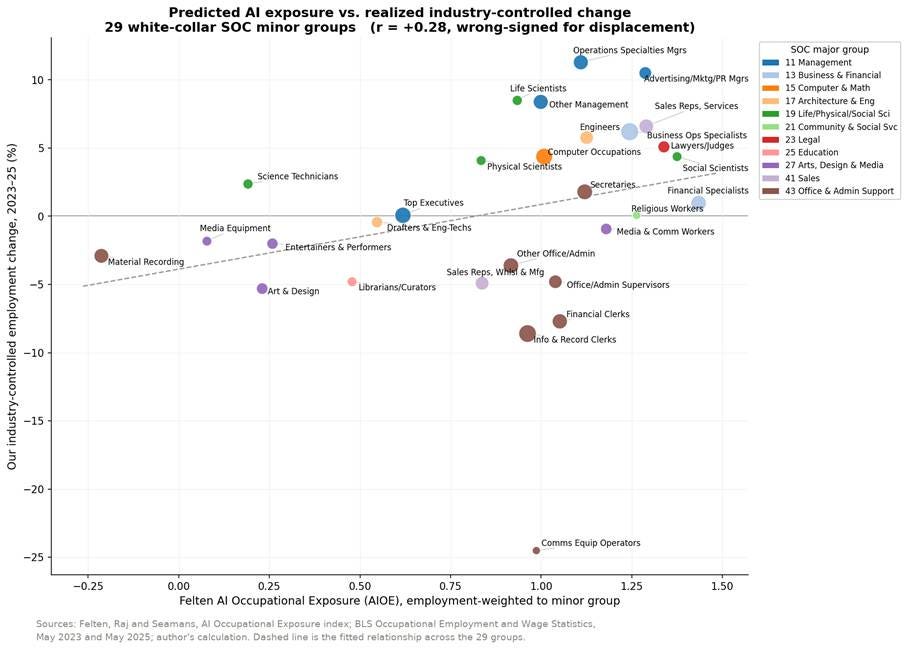
Chart 13. A widely used AI exposure score against what happened to occupations, 2023 to 2025.
That matters. If an exposure measure is simply noisy, estimated effects will tend to be pulled toward zero. If it systematically ranks displacement risk incorrectly, then the regression is testing the wrong thing.
Standard research designs can wash out the effect in other ways too.
One is career stage. A 25-year-old lawyer and a 50-year-old partner share an occupation code, but not really a job. If AI mainly reduces demand for junior work, averaging the two together can make a large entry-level effect look small at the occupation level.
Another problem is that employment is a net outcome. AI is eliminating some jobs while creating others. In the Burning Glass Institute Career History Dataset, I estimate that roughly 1.5 to 2 percent of knowledge workers are now in jobs that would not exist without AI. The AI share of new hires doubled between 2022 and 2025, with new jobs appearing both at AI companies and inside existing firms.
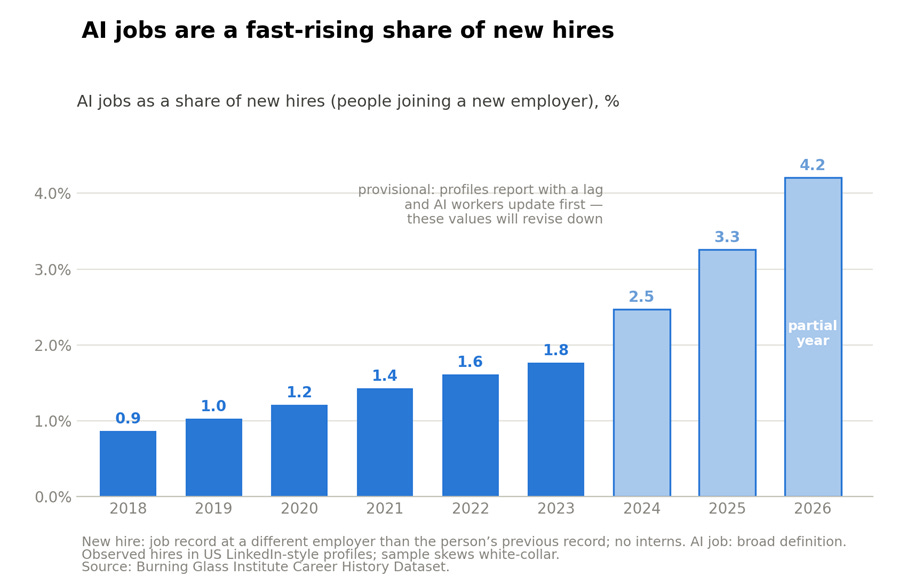
Chart 14. AI jobs as a share of new hires.
That job creation is real and economically important. It also makes displacement harder to see in aggregate employment. Strong AI hiring in one part of the occupation can offset jobs disappearing somewhere else.
Then there are the statistical limitations. Household-survey samples become small quickly once researchers divide workers into narrow exposure groups. That does not bias the estimate, but it widens confidence intervals and makes null results easier to generate.
And attribution is genuinely difficult. High interest rates, the unwinding of pandemic overhiring, federal cuts, immigration changes, offshoring, and older forms of automation all affected many of the same workers over the same period. The data also cannot cleanly separate generative AI from the broader wave of digital automation it is accelerating. That makes AI’s effect hard to isolate with any method, including mine.
But that is precisely why a null result should not be treated as evidence that the effect is small. The question is not just whether an estimate is statistically significant. It is how large an effect the study can actually rule out. Many of the studies cited as evidence that AI has done little cannot rule out economically large effects.
Exposure measures can be useful for describing what AI could affect. But using exposure on its own as the sole proxy for AI’s labor-market impact is a non-starter.
The gains are concentrating in the firms that own the technology
The geography of market value is already shifting. The Bay Area’s share of US stock market capitalization, based on company headquarters, has nearly doubled since 2009, from 17.5 percent to about one-third, even though the region has only about 2 percent of the country’s population.
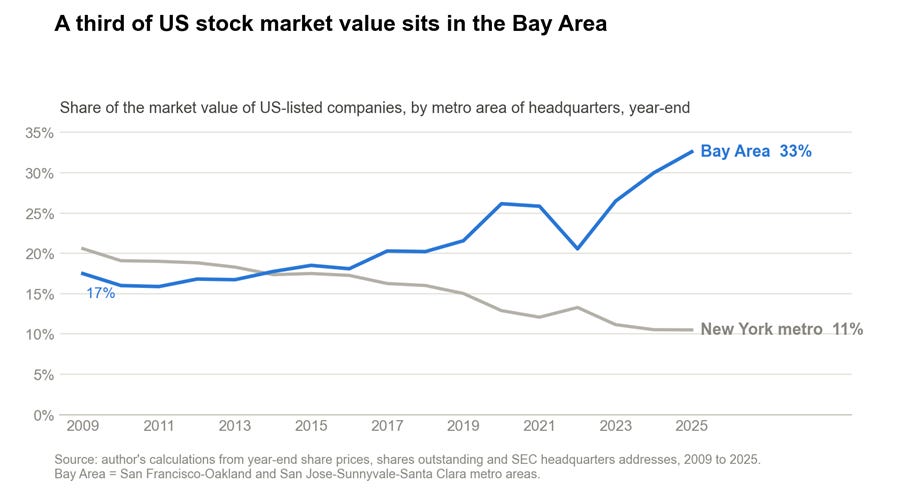
Chart 15. The Bay Area’s share of US stock market value, with the New York metro area for comparison.
That matters because market capitalization reflects expectations about future profits. If today’s valuations are even roughly right, investors are betting that an enormous share of the value created in the coming years will accrue to a relatively small number of technology companies concentrated on the West Coast.
The geography of AI employment points in the same direction.
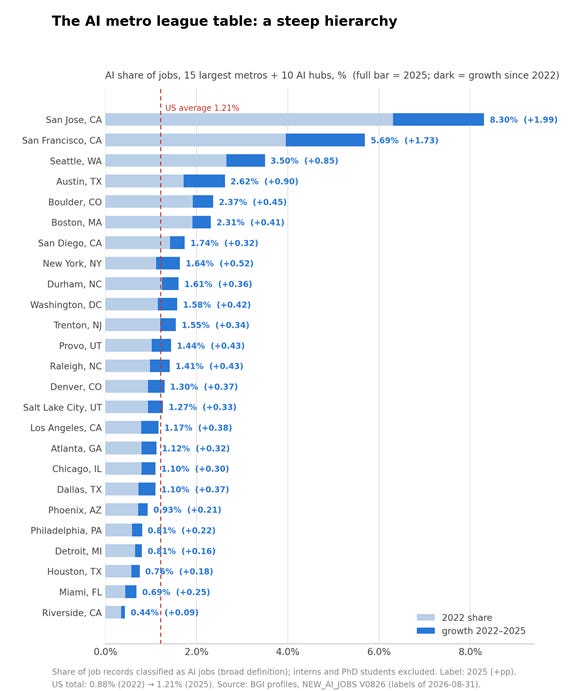
Chart 16. AI jobs as a share of all jobs, by metro area.
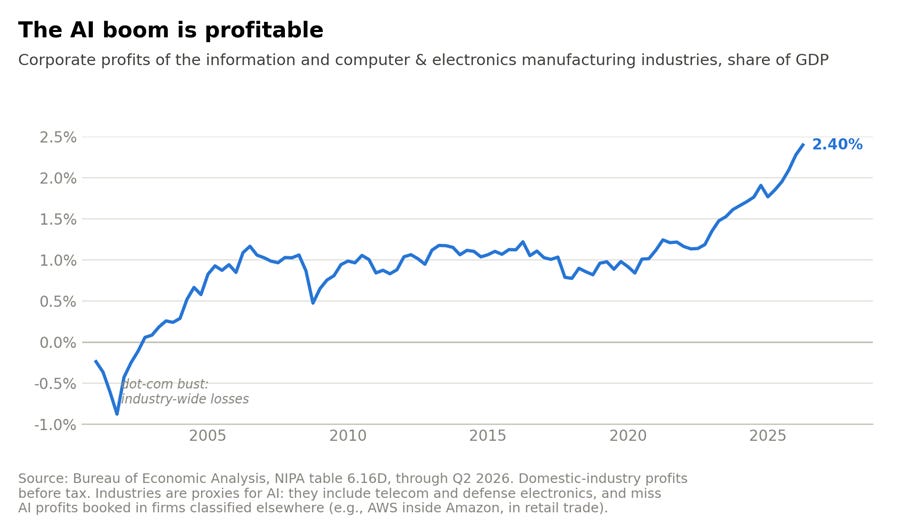
Chart 17. Profits of the information and computer and electronics industries as a share of GDP.
And profits are already becoming more concentrated in technology-intensive industries.
Technology companies do not need to take over hospitals, banks, retailers, or manufacturers to capture more of the value those industries produce. They only need to own more of the infrastructure underneath them: the models, software, computing, payments, logistics, advertising, billing, scheduling, imaging, and other systems that increasingly determine how the work gets done.
A hospital can become more productive without becoming a technology company. But if much of that productivity comes from tools owned elsewhere, some of the economic surplus shifts to the firms that supply them.
That is an important part of the AI story. AI can raise productivity across the economy while concentrating profits in the companies that own the technology. And because those companies are geographically concentrated, part of the redistribution of income and wealth is geographic too.
The big job losses haven’t happened yet. They’ll come in the next recession
What we’ve seen so far is small next to what’s coming. AI has raised what the economy could produce by a lot, and what it actually produces lags behind. That gap is historically large and I expect it to grow, because the technology is improving faster than any company or household could adopt it.
Catching up takes two forms. Businesses and households have to adopt AI, and the economy has to build the capacity to deliver AI at the scale users want, and before that, the capacity to build that capacity. I think this catch-up will be the key feature of the economy for the next several decades.
For young graduates the adjustment has already started. The jobs a degree used to lead to aren’t being filled, so many of them are taking jobs in other locations, other occupations and other companies than they’d planned, and adjusting their career expectations.
Everything so far has happened under conditions that could hardly be kinder to workers. Profits are at a record share of GDP, so no firm has been forced to cut, and the JOLTS layoff rate is running around 1 percent, about as low as that series goes. AI has also been adding jobs while it removes them. Thousands of AI companies start up every year, most of them in a handful of metros with the Bay Area at the front, and I think the larger number of new AI roles is being created inside firms that already exist. My count on the Career History Dataset puts 1.5 to 2 percent of knowledge workers in jobs that would not be there without AI. That leaves out the physical side of the boom altogether. Somebody has to build the data centers, the power plants, the transmission lines and the fabs, and that work has gone to electricians, construction crews, engineers and technicians in large numbers, none of whom appear in any count of AI jobs. Displacement is hardest to see in exactly this setting.
Put those conditions together and you get this year’s wave of articles declaring the AI job apocalypse dead. I think they’re premature. Displacement mostly happens in recessions, and there hasn’t been one. Manufacturing is the warning. In 2000 the effect of automation on factory employment looked modest. By 2010, after the 2001 and 2008 recessions had pushed firms to reorganize around the technology, it didn’t.
I expect big cuts in office jobs when the next recession comes. Recessions are when the layoffs come, and the jobs that technology has already made unnecessary don’t come back afterward. The hiring side of this is happening now. The layoff side waits for the recession.
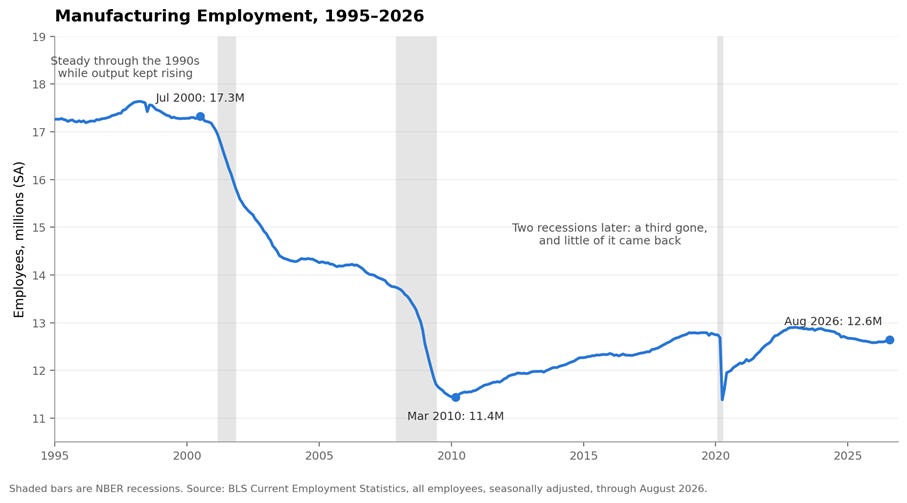
Chart 18. Manufacturing employment, 1995 to 2026.
The consensus is not a harmless mistake
The reading that AI hasn’t touched the labor market yet is not a neutral one. It tells policymakers there is nothing to prepare for. It tells colleges to keep producing graduates for entry-level jobs that are getting scarcer. It tells a 23-year-old with a degree and no offers that the problem is bad luck, when part of it is structural, and the structural part won’t reverse. If I’m right about the next recession, all of that becomes much harder to miss, and by then employers will have had years to learn where AI substitutes for labor. The adjustments that are cheap now, in what students study and in how firms build their junior pipelines, get expensive then. That young graduates are struggling in conditions this favorable is the part that worries me most.
Your anticipatory-hiring point shows up in what executives say on earnings calls. I went through 4,335 calls from S&P 500 companies outside tech since January 2024 and pulled every passage where an executive tied AI to the company's own headcount. It's still rare, 41 calls, but the share went from 0.51% of calls in 2024 to 1.38% this year.
Most of it is the version you describe. On 22 of the 41 calls the claim was that AI lets the company grow without adding people, and on 5 more that people who leave won't be replaced. Only 14 described cuts.
It also lines up with your FIIPB pattern. Financial companies made 20 of the 41 claims, on 2.58% of their calls against 0.95% for the whole sample. Bank of America's CEO said in April the bank hires about 1,300 people a month just to stay level, so it can "let attrition be your friend," and that AI "gives us places to go we haven't gone."
Write-up with each quote linked to its call (I work at Equibles, where it's published): https://equibles.com/research/is-ai-cutting-jobs-outside-tech-evidence-from-4-335-s-p-500-earnings-calls
The entry-level pipeline is the part I worry about too. Businesses have always used junior roles to build judgement through real work. If AI absorbs many of the routine tasks, employers need a deliberate alternative: supervised decisions, customer exposure, exception handling and review. Otherwise they may save time today and discover later that they stopped developing experienced people.