
Economic Outlook

Executive Summary
The way I view the economic outlook is different from most. In a typical year, the gap between actual and potential GDP is small, and the economist’s job is to argue about the cycle. That is not the situation we are in.
Generative AI is a major, unusually fast technological shock. The path from ChatGPT to Claude Code took less than three years, and the frontier is still rapidly advancing. AI-driven potential GDP has jumped sharply. Actual GDP is far behind. The gap is now unusually large, and it is the central feature of the macro outlook. The main narrative is no longer cyclical fluctuation around trend. It is catch-up.
Several channels are already closing the gap. AI infrastructure investment is adding to demand today and capacity tomorrow. Workers in exposed sectors are becoming more productive. Profits are funding the next round of investment. Equity-market gains are supporting consumption. Together, these forces are large enough to explain three things that puzzled forecasters in 2025: why growth held up at roughly 2.0–2.5 percent despite tariffs, federal workforce cuts, immigration restriction, and high uncertainty; why output kept rising even though job growth was barely positive; and why consumer spending stayed solid even though hiring did not.
The next 12 months extend that story rather than break from it. AI capability keeps improving. Adoption accelerates as 2025’s experimentation phase gives way to broader deployment. The buildout intensifies — hyperscaler 2026 capex plans are getting even larger, Q1 earnings produced very strong growth rates, and stock prices are rapidly rising. Most of 2025’s headwinds are spent. Iran is a real energy tax on the expansion, not the story of it. New shocks will arrive, but the 2025 precedent is that AI’s offsetting capacity is now larger, not smaller.
The main story of the next 12 months is AI, not Trump.
Setting the Stage
Generative AI is a major technological shock — and an unusually fast one. The technology is improving rapidly, and equity markets are already pricing in a structural shift, with tech valuations reflecting investor confidence that the trajectory will continue well into the future.
The implication is a sharp upward break in potential GDP.
Potential GDP is usually defined as the level of output the economy can sustain when labor and capital are employed at normal rates and existing technology is adopted at normal rates. But that last phrase matters. Frontier technology is never fully adopted across all firms. There is always a gap between what the best organizations can do and what the average organization actually does. So “normal adoption” should be understood as the typical gap between the frontier and the average firm. This is broader than the CBO’s measured-potential concept; it is closer to economically feasible output given the current technological frontier.
By that definition, actual GDP may now be well below AI-driven potential GDP. And because the frontier is advancing faster than diffusion, the gap may widen before it narrows.
That would be unusual. In most downturns, actual GDP falls below potential because demand weakens. In this case, the gap opens because the technological frontier jumps ahead faster than firms, workers, institutions, and infrastructure can absorb it.
The historically high market capitalization of the U.S. tech sector is one signal of that gap. Markets are not measuring potential GDP directly. They are pricing expected profits, market power, discount rates, and global demand. But they are also pricing a future in which AI creates economic value that has not yet fully appeared in measured GDP.
That makes catch-up the central macroeconomic frame for the next several years.
The key question is not only how much AI raises potential GDP. It is how quickly actual GDP catches up.
Channels Through Which Actual GDP Catches Up to AI-Driven Potential
The catch-up process will not happen through one mechanism. It will happen through several channels operating on different timelines.
Some are already visible in 2026. Others are emerging but not yet fully reflected in the macro data. A few are likely to matter more after 2026.
Already clearly at work in 2026
1. AI infrastructure investment raises demand now and capacity later. Companies and countries are spending heavily on data centers, chips, cloud infrastructure, software, networking, and power. This investment supports GDP growth today while building the capital stock needed to deploy AI at scale tomorrow.
2. Workers become more productive. AI helps workers produce more in the same amount of time. Firms can use that productivity to reduce headcount, deliver the same output faster and better, or produce more with the same workforce.
3. Higher profits finance more investment. AI can widen margins for firms that adopt it successfully. Those profits can fund additional investment, support dividends and buybacks, or strengthen balance sheets — all of which reinforce spending elsewhere in the economy.
4. Stock-market wealth supports consumption. AI expectations have boosted equity valuations, especially among the largest technology firms. That creates a wealth-effect channel before the full productivity gains show up in GDP.
Emerging in 2026, but not yet fully visible
5. Firms reorganize around AI. The largest productivity gains will not come from bolting chatbots onto existing workflows. They will come from redesigning workflows themselves: flattening management layers, automating handoffs, reducing coordination costs, and shifting workers toward higher-value tasks. Many firms have started this transition. Few have completed it.
6. Labor and capital move toward more productive firms. AI will not raise productivity evenly. Firms that use it well will gain customers, workers, capital, and market share. As output shifts toward those firms, aggregate productivity rises beyond what within-firm efficiency gains alone can deliver.
7. Lower prices raise real incomes. As AI lowers production costs, some savings should eventually pass through to prices. That raises purchasing power and supports demand. This may show up first in business services, where AI directly reduces the cost of producing research, code, analysis, legal work, design, customer support, and back-office processes.
8. AI creates new products, services, and markets. AI makes it possible to provide services that were previously too expensive to deliver at scale, or that simply did not exist. ChatGPT and Claude Code are early examples, not the end state.
Mostly later than 2026
9. Macroeconomic policy can accommodate faster growth. If AI raises supply faster than demand, inflation pressure should ease. That gives the Fed more room to accommodate growth and leaves interest rates lower than they otherwise would have been.
10. Faster growth improves government revenue. Faster growth raises tax revenue, creating room for lower taxes, smaller deficits, or reduced government borrowing. That can put downward pressure on interest rates and support additional private investment.
The Feedback Loop
11. Several channels have multiplier effects. AI infrastructure spending becomes revenue for suppliers. Supplier revenue becomes worker income, profits, and follow-on investment. Stock-market gains support consumption. Productivity gains support margins. Higher margins support additional investment. The initial AI-driven boost to demand is therefore amplified through the rest of the economy.
The Offsetting Force: AI Can Weaken Labor Income During the Transition
The same process that raises potential GDP can temporarily weaken actual GDP.
If firms automate tasks, cut employment, or slow wage growth before displaced workers are reabsorbed elsewhere, aggregate labor income suffers. That reduces household purchasing power and weighs on consumption. That can lower consumption growth, and partly offset some of the positive factors impacting GDP, especially in the earlier years.
Applying the Framework to the 2025–2026 Economy
The framework above helps explain one of the biggest surprises of the past year: the U.S. economy held up despite a set of headwinds that, in a normal cycle, would have produced much weaker growth. Tariffs, immigration restriction, federal workforce cuts, weak job growth, and higher energy prices all pushed in the wrong direction.
Many forecasters expected a self-inflicted recession, or at least a sharp slowdown. Instead, the economy kept growing at a solid pace — probably somewhere around 2.0 to 2.5 percent over the past year, depending on the measure. With population growth slowed sharply by immigration restriction, per-capita output rose close to the full headline pace.
The headwinds were real. The surprise is that they were offset by the first visible wave of AI-related macro forces.
Why GDP Held Up: The AI Investment Boom
The most visible support came from business investment. Companies are spending heavily on data centers, chips, cloud infrastructure, software, networking, power, and related equipment.
The chart below (from BEA) captures this through investment in R&D, software, and information-processing equipment — categories that include much of what we loosely call AI capex. The most recent readings are the highest reading in 65 years of data. Higher than any quarter of the dot-com buildout. Not all of this spending is strictly AI, but these categories are closely tied to the AI buildout and to the integration spending that comes with it: software, consulting, workflow redesign, and organizational adaptation.
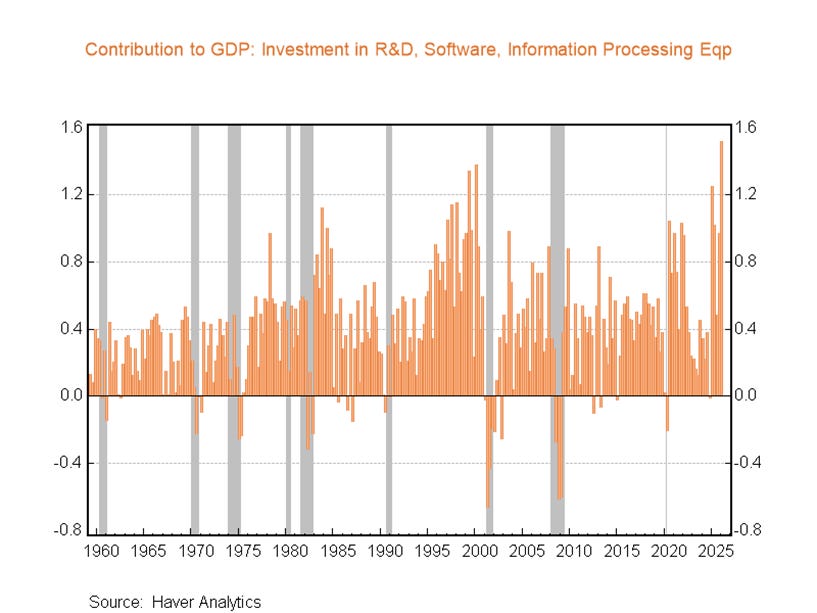
This is why AI capex matters for the current outlook, not just the long-run productivity outlook. It adds directly to GDP through business investment, then ripples outward through construction, utilities, chipmakers, equipment suppliers, engineers, software vendors, and local workers. The visible policy shocks were negative, but the less visible AI investment cycle was strongly positive.
The investment boom was also supported by historically high profitability. Strong productivity growth in several AI-exposed industries helped lift margins, giving firms the internal cash flow to finance the next round of spending on data centers, chips, software, power, and organizational change.
Why Weak Hiring Did Not Mean Weak Output: Productivity
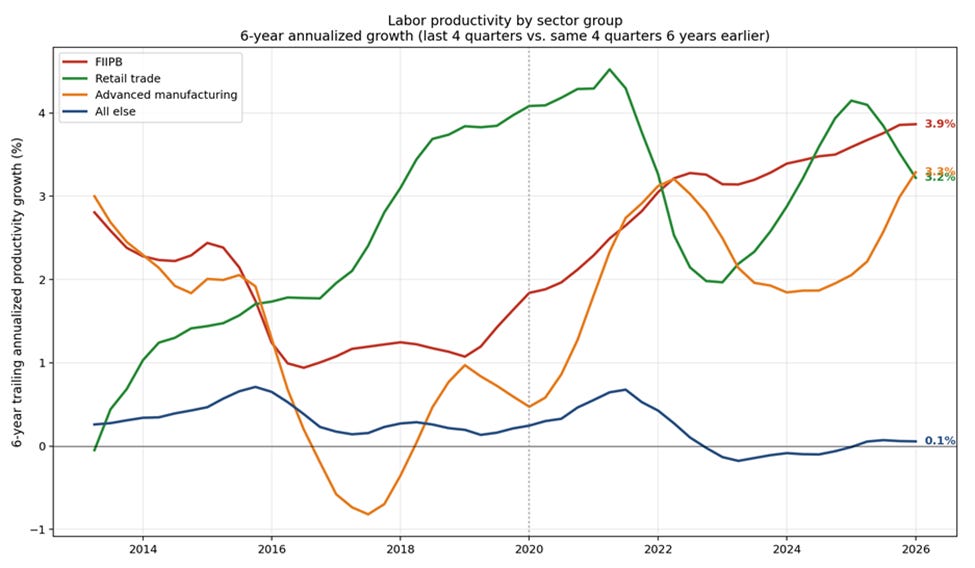
Job growth has been barely positive over the past 12 to 18 months, but GDP has continued to grow solidly. The most plausible explanation is a structural productivity acceleration concentrated in the sectors most exposed to digital tools and AI: finance, insurance, information, professional and business services, retail, and advanced manufacturing.
Source: BEA GDP by Industry, BLS Current Employment Statistics
These are the sectors where the old relationship between output and labor input has started to break. Output keeps rising while hours and employment grow much more slowly, and in some cases barely grow at all.
Why Consumption Held Up: Income, Saving, and Wealth
The same weak-hiring pattern creates the second puzzle: why did consumption hold up?
The reason is that employment, income, and spending have decelerated at different speeds. Employment growth has slowed the most. Real disposable personal income has slowed too, but less dramatically, because wages and salaries have continued to rise faster than inflation. Real consumer spending has grown faster still, above 2 percent in the earlier chart. The gap between income growth and consumption growth has been filled by a lower saving rate.
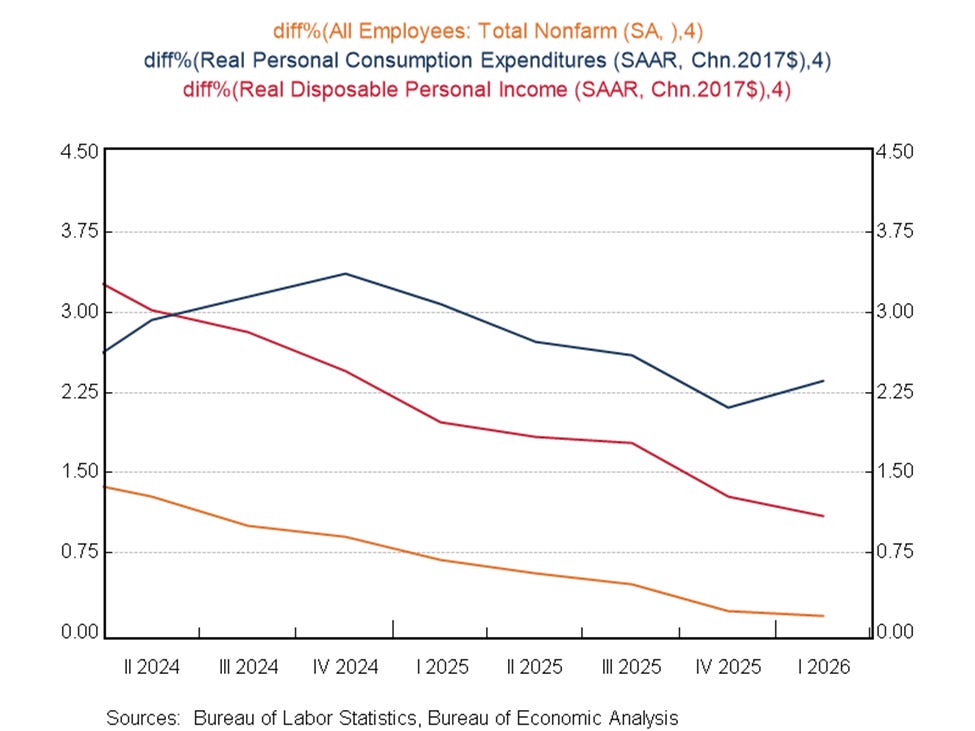
This is where the AI wealth channel matters. If AI expectations raised the market value of the largest technology companies, they also raised the wealth of households exposed to those firms.
This makes the consumer outlook stronger than the labor market alone would imply. Real income is still growing, wealth effects have not fully played out, and households have been willing to save less.
What It Means for the Next 12 Months:?
The next 12 months split cleanly. AI is the story. Policy is noise.
That is not where most forecasters are. The consensus view going into 2026 is for growth to slow modestly toward trend. Recession risk is often mentioned. Policy — tariffs, immigration, federal layoffs — is treated as the swing variable. AI is acknowledged as a long-run productivity story but not as a near-term macro driver. I think that framing has the wiring backwards. The forces consensus treats as decisive in the next 12 months are largely spent. The force consensus treats as long-run is already carrying GDP in the quarterly data. The 2025 precedent is the tell: the same forecasters who expected a self-inflicted recession last year missed because they underweighted the AI investment cycle and the productivity acceleration. Repeating that mistake in 2026 is the central forecasting risk, not avoiding it.
AI advances on three fronts at once.
Capability keeps improving. Adoption is accelerating — 2025 was the year firms experimented; 2026 is the year they deploy. And actual GDP keeps catching up to AI-driven potential.
Capex isn’t just continuing, it’s expanding. Hyperscaler guidance for 2026 is bigger than it was six months ago. Power, chips, construction — all running hotter. AI investment is now visibly carrying GDP in the quarterly data. Q1 earnings did the rest: earnings growth and net margins are both running at multi-year highs.
Adoption is the bridge from buildout to broad productivity. As many firms move from experimentation to deployment, channels 5 through 8 — workflow redesign, lower task costs, reallocation, eventually lower prices — start showing up in the macro data.
Job growth remains very weak. Unemployment among recent college graduates keeps rising — entry-level white-collar work is where substitution is fastest. The wealth channel and a still-falling saving rate carry consumption through the year.
The 2025 headwinds are largely exhausted. Federal workforce cuts have run through the data. Tariff price effects are absorbed. Border crossings have been near zero for many months, with no further tightening to come.
Iran matters but stays in proportion. The energy shock is a tax on the expansion. The economy has shown it can absorb the disruption.
The main story is AI, not Trump.
Hello I have cited you in numerous articles (most recently at Unherd). I write for a lot of people and co-teach a class on social implications of AI. Also have a podcast with 10,000 regular viewers and would like to invite you on the show.
Interested? Let me know. My email is joel@joelkotkin.com
thanks